
Arrhythmia Surgery

UNDERSTANDING
ARRHYTHMIA SURGERY
Minimally Invasive & Open Heart
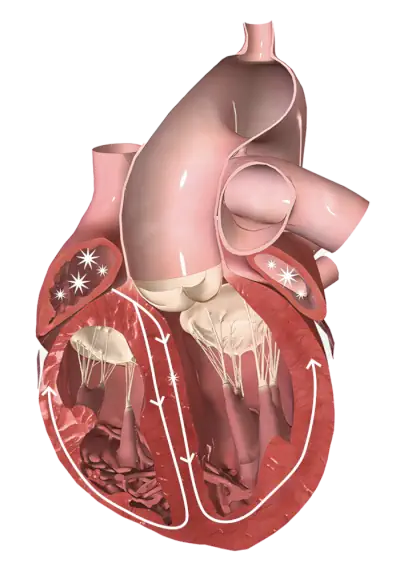
Many people experience irregular heart rhythms, with atrial fibrillation being the most common. This condition, where the atria beat out of sync with the ventricles, can cause blood clots and strokes, as well as reduced heart efficiency and fatigue. While medication manages many cases, some require surgery.
APPROACHES
Minimally Invasive
A catheter (a thin, flexible tube) is inserted through a vein, typically through the neck or groin and guided into the heart.
The catheter delivers hot or cold energy to the heart tissue, creating scars that block irregular or abnormal heart rhythms.
Small incisions are made in the chest.
A catheter is inserted to treat the arrhythmia-causing signals.
Uses a catheter to insert a special device to close or block the atrial appendage.
The area is sewn or stapled closed.
Open Heart
Performed using hot or cold energy to create scar lines in the heart, which blocks the electrical signals causing the arrhythmia.
Uses a catheter to insert a special device to close or block the atrial appendage.
The area is sewn or stapled closed.
CONDITION TREATED
Surgery is recommended for patients with:
Minimally Invasive
- Atrial Fibrillation
- Atrial Flutter
Open Heart
- Atrial Fibrillation
- Atrial Flutter
- Usually Atrial Fibrillation That Presents With Other Complex Heart Conditions (E.g. Multiple Coronary Blockages & Multiple Valve Diseases At The Same Time)
WHAT TO EXPECT
Minimally Invasive
- Thorough assessment including medical history, physical examination, and advanced imaging (e.g., echocardiogram, CT scan).
- Consultation with (Adj) Professor Theo Kofidis to explore minimally invasive & open heart options, their potential benefits & risks, and if patient qualifies for minimally invasive surgery.
Open Heart
- Thorough assessment including medical history, physical examination, and advanced imaging (e.g., echocardiogram, CT scan).
- Consultation with (Adj) Professor Theo Kofidis to explore minimally invasive & open heart options, their potential benefits & risks, and if patient qualifies for minimally invasive surgery.
Minimally Invasive
- General anaesthesia is administered for comfort.
- Radiofrequency ablation performed using the Cobra-Fusion device through small incisions, minimising tissue trauma.
Open Heart
- General anaesthesia administered for comfort.
- Radiofrequency ablation performed during open-heart surgery, which involves opening the chest cavity.
Minimally Invasive
- Usually 1 day in ICU & 3-4 days in general ward.
- Faster mobilisation and return to daily activities.
- Follow-up appointments to monitor healing progress and overall cardiac health.
Open Heart
- Usually 2 days in ICU & 5-7 days in general ward.
- Slower mobilisation while in recovery.
- Follow-up appointments to monitor healing progress and overall cardiac health.
BENEFITS
Minimally Invasive
Less pain & quicker recovery period.
Results in smaller scars that are less visible.
Regain strength and mobility faster, allowing you to resume normal activities sooner.
Smaller incisions reduce the risk of post-surgical infections, leading to safer recovery.
Minimises blood loss, decreasing the need for transfusions.
Reduced physical trauma to the body facilitates quicker healing and less post-operative pain.
Lowers the likelihood of irregular heartbeats, enhancing overall cardiac stability post-surgery.
Preserving chest structure promotes improved lung function and breathing capacity shortly after surgery.
Smaller incisions result in less visible scarring, maintaining a more natural appearance.
Open Heart
In cases where the heart anatomy is complex or the arteries are severely diseased, open heart surgery may offer a more reliable option for complete revascularization.